Summary
Investors often focus on predicting market highs and lows, but long-term evidence suggests that time horizon typically matters far more than precise market timing. Staying invested over many years allows compounding and market growth to work in your favor. This article explains why long-term investing tends to outperform short-term timing attempts and how investors can build wealth through patience and disciplined strategy.
Understanding the Difference Between Time Horizon and Market Timing
Many investors ask the same question: “Should I wait for the market to drop before investing?” The instinct is understandable. Buying at the lowest price and selling at the highest appears to be the most profitable strategy.
However, real-world investing rarely works that way.
Market timing refers to attempts to predict short-term market movements—entering or exiting investments based on expected price changes. Time horizon, by contrast, refers to how long an investor plans to remain invested.
The distinction matters because markets are notoriously unpredictable in the short term but historically resilient over longer periods. While short-term fluctuations dominate headlines, long-term investors often benefit simply by remaining invested through cycles.
Financial research repeatedly shows that trying to predict market movements is extremely difficult—even for professionals.
For example, data from long-term studies of the U.S. stock market shows that missing just a handful of the market’s best-performing days can significantly reduce total returns. Because these days often occur close to market downturns, investors who exit during volatility may unintentionally miss the recovery.
In practical terms, the longer your investment horizon, the less important precise entry timing becomes.
Why Predicting Market Timing Is So Difficult
The idea of timing the market assumes that investors can reliably anticipate future events. In reality, markets respond to complex forces including:
- economic indicators
- global events
- monetary policy
- corporate earnings
- investor sentiment
Even small surprises can trigger sharp movements.
Professional fund managers with access to extensive research teams frequently struggle to consistently outperform market benchmarks. According to annual scorecards published by S&P Dow Jones Indices, many actively managed funds fail to beat their benchmark indices over long periods.
That reality highlights a central truth of investing: predicting short-term movements is extremely challenging.
Consider a typical market cycle. News headlines may highlight uncertainty, prompting investors to sell. Yet markets often rebound quickly when new information emerges. By the time conditions appear safe again, prices may already have recovered.
As a result, investors who move in and out of markets frequently risk missing the periods when gains occur.
The Power of Long-Term Market Participation
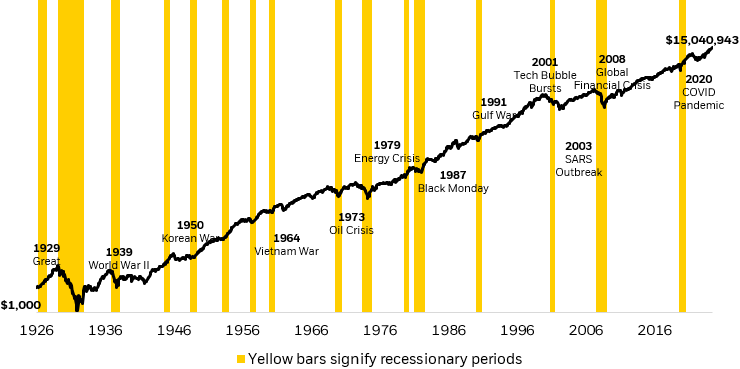
Time horizon matters because markets historically trend upward over long periods, even though they fluctuate in the short term.
The U.S. stock market has experienced recessions, inflation spikes, financial crises, and geopolitical shocks. Yet over decades, the overall trajectory has remained positive.
For example, historical analysis of the S&P 500 shows:
- Over single-year periods, returns can vary widely.
- Over 10-year periods, the likelihood of positive returns increases significantly.
- Over 20-year horizons, historically there have been very few negative outcomes.
This pattern reflects economic growth, corporate innovation, and productivity improvements over time.
Long-term investors benefit from these trends because they remain invested through downturns and recoveries alike.
Another powerful force is compound growth—the ability for investment returns to generate additional returns over time.
A = P(1+r)^t
In this formula, investment value grows exponentially as time increases. The longer the horizon, the greater the impact of compounding.
This is one reason retirement planning often emphasizes early investing. Even modest contributions can grow significantly over decades.
What Happens When Investors Try to Time the Market
To understand the difference between timing and staying invested, consider a simplified scenario.
Imagine two investors:
Investor A invests steadily and remains invested for 20 years.
Investor B moves money in and out of the market attempting to avoid downturns.
If Investor B misses several of the market’s strongest days during that period, total returns may be significantly lower—even if they correctly avoided some declines.
This occurs because market rebounds often happen quickly. Missing just a few high-performing days can materially reduce overall performance.
Research frequently cited in investment literature shows that a large percentage of total long-term market gains occur during relatively short time windows.
Because predicting those moments is extremely difficult, staying invested becomes a more reliable strategy for many investors.
Why Time Horizon Reduces Investment Risk
Short-term market volatility can feel unsettling. Prices may move dramatically within weeks or even days.
However, time horizon often reduces the impact of volatility.
Consider the difference between a one-year investment window and a 20-year horizon.
Over one year:
- Market returns may swing widely.
- Economic news can create sudden price shifts.
- Investor sentiment can drive short-term volatility.
Over two decades:
- Economic cycles tend to balance out.
- Market recoveries follow downturns.
- corporate growth contributes to long-term expansion.
This is why financial planners typically recommend adjusting investment strategies based on time horizon.
For example:
- Longer horizons (10+ years): higher allocation to growth assets like stocks
- Medium horizons (5–10 years): balanced portfolios
- Short horizons (under 3–5 years): more stable assets such as bonds or cash equivalents
Time horizon helps determine how much volatility an investor can realistically tolerate.
Dollar-Cost Averaging: A Practical Approach for Long-Term Investors
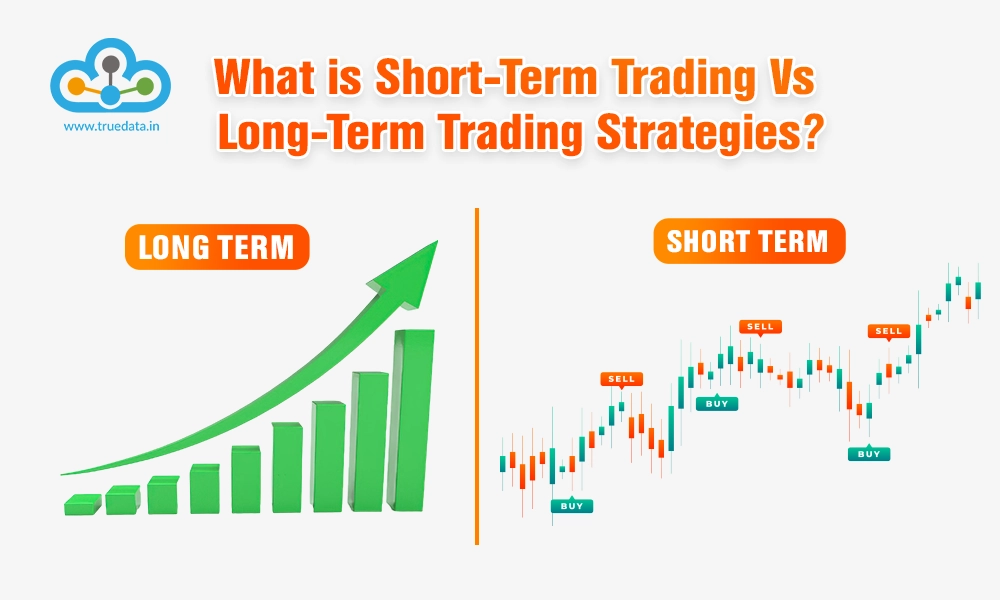
Many investors address market uncertainty using dollar-cost averaging.
This approach involves investing a fixed amount at regular intervals, regardless of market conditions.
Over time, this method can help smooth out the effects of market volatility because investors buy shares at different prices.
Key benefits include:
- Reduces pressure to find the “perfect” entry point
- Encourages consistent investing habits
- Helps investors stay committed during market swings
For example, retirement contributions to employer-sponsored plans often follow this structure automatically. Each paycheck contributes funds to investments over many years.
The strategy aligns closely with the principle that consistent participation over time often matters more than precise timing.
How Professional Investors Think About Time Horizon
Institutional investors such as pension funds and university endowments typically operate with very long time horizons.
These organizations manage assets intended to support beneficiaries for decades. Because of that, they often structure portfolios with a long-term perspective.
Common characteristics of long-horizon investment strategies include:
- diversified asset allocations
- disciplined rebalancing
- limited reaction to short-term news
- focus on long-term economic growth
While individual investors have different goals and timelines, the same principles often apply.
Investors who align strategies with their time horizon may be better positioned to navigate volatility without making reactive decisions.
Common Questions Investors Ask About Market Timing
Many investors continue to search for signals indicating when to buy or sell.
Some of the most frequently asked questions include:
- Is now a good time to invest?
- Should I wait for the next market correction?
- What if the market drops right after I invest?
The reality is that markets rarely move in predictable patterns.
Short-term downturns are a normal part of investing. Historically, markets have experienced numerous corrections and bear markets, yet long-term upward trends have persisted.
For investors with multi-year or multi-decade horizons, short-term movements often become less significant when viewed in the broader context.
Practical Steps for Investors With Long Time Horizons
Investors who want to prioritize time horizon over timing can focus on several practical principles.
Define your investment timeline clearly
Understanding whether your goal is five, ten, or thirty years away helps determine appropriate strategies.
Build diversified portfolios
Diversification spreads risk across multiple asset classes and sectors.
Invest consistently
Regular contributions allow investors to benefit from dollar-cost averaging.
Avoid reactive decision-making
Markets move in cycles, and reacting to short-term news can disrupt long-term plans.
Review portfolios periodically
Adjusting allocations over time ensures investments remain aligned with financial goals.
These steps do not eliminate risk, but they can help investors maintain discipline during volatile periods.

FAQ: Time Horizon vs Market Timing
Why is time horizon important in investing?
Time horizon determines how long investments have to grow and recover from volatility. Longer horizons generally provide greater opportunity for compounding and market recovery.
What does timing the market mean?
Timing the market refers to attempting to buy investments at their lowest prices and sell them at their highest, based on predictions about market movements.
Is it possible to consistently time the market?
Consistently timing the market is extremely difficult. Even professional investors rarely achieve reliable success in predicting short-term market movements.
What is the benefit of long-term investing?
Long-term investing allows investors to benefit from compound growth and historical market trends while reducing the impact of short-term volatility.
How long should a typical investment horizon be?
Investment horizons vary depending on financial goals. Retirement investing often spans 20–40 years, while shorter goals may require more conservative strategies.
Does investing early really make a difference?
Yes. Starting earlier gives investments more time to compound, which can significantly increase long-term portfolio growth.
What happens if the market drops after I invest?
Short-term declines are normal. Investors with long time horizons often stay invested to allow time for potential recovery.
Should I stop investing during market downturns?
Many financial professionals recommend continuing regular contributions during downturns, which may allow investors to purchase assets at lower prices.
Is diversification important for long-term investing?
Yes. Diversification helps reduce risk by spreading investments across different asset classes and industries.
Can short-term trading outperform long-term investing?
Some traders may achieve success, but consistently outperforming long-term strategies through frequent trading is difficult and uncommon.
The Advantage of Patience in Financial Markets
Successful investing often reflects patience rather than prediction. While market headlines focus on daily fluctuations, long-term investors typically focus on broader trends such as economic growth, innovation, and productivity.
By aligning investment strategies with realistic time horizons, investors may reduce the pressure to anticipate every market movement. Instead of attempting to predict short-term shifts, many investors concentrate on consistent participation and disciplined portfolio management.
Over time, this approach allows the fundamental drivers of economic growth and compounding to play a greater role in financial outcomes.
Key Insights at a Glance
- Long investment horizons reduce the importance of precise market timing
- Short-term market predictions are extremely difficult to make consistently
- Missing a few of the market’s strongest days can significantly impact returns
- Compound growth becomes more powerful over longer periods
- Consistent investing strategies often outperform reactive decision-making