Summary
Many experienced investors prioritize long-term market participation because financial markets historically reward patience, consistency, and disciplined investing. Rather than attempting to predict short-term price movements, long-term investors focus on staying invested through market cycles, benefiting from compounding returns and economic growth over time. This approach helps reduce emotional decision-making while supporting sustainable wealth building.
Understanding the Idea of “Long-Term Market Participation”
Long-term market participation refers to the strategy of remaining invested in financial markets for extended periods—often decades—rather than frequently entering and exiting based on short-term price movements. This philosophy is widely discussed among financial planners, institutional investors, and retirement experts in the United States.
The reasoning behind this approach is rooted in how markets function over time. Financial markets reflect the productivity, innovation, and economic growth of companies. While prices fluctuate daily due to news, sentiment, and macroeconomic factors, long-term trends tend to track broader economic expansion.
For individual investors, participating in markets over long periods allows them to benefit from these structural growth patterns without needing to predict short-term movements that even professionals struggle to forecast reliably.
Research from firms such as Vanguard and Fidelity consistently shows that investors who remain invested across market cycles tend to experience more stable long-term outcomes than those who attempt frequent timing decisions.
The Historical Case for Staying Invested
One of the strongest arguments for long-term participation is historical market performance. Over extended periods, equity markets have generally trended upward despite periods of volatility.
According to long-term market data compiled by financial research institutions:
- The U.S. stock market has historically produced average annual returns around 9–10% before inflation over many decades.
- Markets have experienced multiple recessions, wars, and financial crises during that time.
- Yet long-term investors who stayed invested generally recovered and continued to grow their portfolios.
This does not mean markets rise smoothly. Instead, they move through cycles of expansion and contraction. Long-term investors accept that volatility is part of the process.
Consider a practical example.
An investor who began investing in a diversified U.S. index fund in the early 1990s would have experienced:
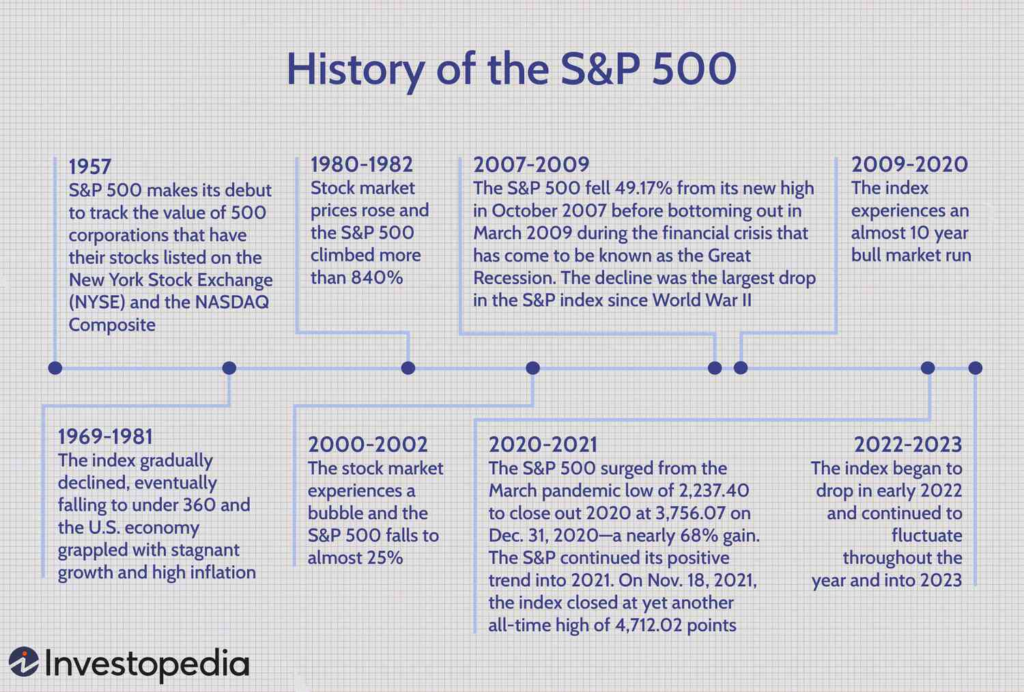
- The dot-com crash
- The 2008 global financial crisis
- The COVID-19 market downturn
Despite those events, long-term returns over that period remained positive due to the market’s eventual recovery and growth.
Why Market Timing Is So Difficult
Many investors are tempted to move in and out of markets to avoid downturns. While this approach may seem logical, consistently predicting short-term movements is extremely challenging.
Professional fund managers with extensive research teams often struggle to outperform the market consistently. For individual investors, the challenge is even greater.
Several factors make market timing difficult:
- Unpredictable news events that influence markets instantly
- Rapid market rebounds, which often occur before investors reenter
- Emotional decision-making during volatility
- Complex global economic forces
Data frequently cited by investment firms shows that missing just a handful of the market’s best days can significantly reduce long-term returns.
Because those strong days often occur during volatile periods, investors who exit markets during downturns may miss critical recovery phases.
The Role of Compounding Over Time
Long-term participation allows investors to benefit from one of the most powerful forces in finance: compound growth.
Compounding occurs when investment returns generate additional returns over time.A=P(1+r)t
Where:
- A = final value
- P = initial investment
- r = annual return
- t = number of years invested
Even moderate returns can grow significantly when allowed to compound over decades.
For example:
- $10,000 invested at a 7% annual return
- Over 30 years
- Could grow to approximately $76,000 without additional contributions
Many investors strengthen this effect through regular contributions, such as monthly retirement investments.
Why Retirement Planning Encourages Long-Term Participation
In the United States, long-term market participation is closely linked with retirement planning.
Tax-advantaged retirement accounts such as 401(k)s, IRAs, and Roth IRAs are designed specifically for long-term investing.
These accounts encourage investors to:
- Invest regularly over decades
- Maintain diversified portfolios
- Avoid frequent withdrawals or trading
Employers often contribute matching funds to retirement accounts, further reinforcing long-term investing behavior.
For example, an employee who contributes consistently to a 401(k) over 30 years may accumulate substantial retirement savings largely through market participation and compounding growth.
How Long-Term Investing Reduces Emotional Decisions
One often overlooked benefit of long-term participation is behavioral discipline.
Short-term market movements can trigger strong emotional responses, including:
- Fear during market downturns
- Overconfidence during bull markets
- Impulsive buying or selling
Investors who commit to long-term strategies often create systems that help limit emotional reactions.
Common practices include:
- Automatic monthly investing
- Diversified portfolios
- Pre-defined asset allocations
- Periodic portfolio rebalancing
These systems shift focus away from daily price movements and toward long-term financial goals.

What Long-Term Investors Typically Focus On
Rather than chasing short-term gains, long-term investors often concentrate on core financial principles.
Common priorities include:
- Diversification across asset classes and sectors
- Low investment costs, including index funds and ETFs
- Regular contributions, especially through retirement accounts
- Risk management through balanced portfolios
- Patience during market volatility
Many experienced investors view market downturns not as failures of the strategy but as normal phases within long investment cycles.
Real-World Example: A Consistent Investor
Consider a hypothetical example.
Maria, a public school teacher in Illinois, began investing in her employer’s retirement plan at age 28.
Her strategy was simple:
- Contribute 10% of her salary
- Invest primarily in diversified index funds
- Increase contributions when her salary increased
- Avoid reacting to market headlines
Over time she experienced several market declines, including the 2008 financial crisis. However, by continuing to invest during downturns, she accumulated additional shares at lower prices.
After three decades of consistent investing, Maria’s portfolio growth reflected both market returns and compounded contributions.
This type of disciplined participation is common among long-term retirement savers.
Long-Term Participation Does Not Mean Ignoring Risk
While long-term investing emphasizes patience, it does not mean ignoring risk.
Investors still need to consider:
- Appropriate asset allocation
- Personal risk tolerance
- Time horizon
- Liquidity needs
For example, younger investors often hold higher allocations to equities, while individuals approaching retirement may gradually increase exposure to bonds or other stabilizing assets.
Portfolio diversification remains an important tool for managing volatility during long investment horizons.
When Long-Term Investing May Be Most Effective
Long-term participation tends to work best under certain conditions:
- When investors maintain diversified portfolios
- When investments are aligned with long financial timelines
- When investors avoid frequent trading
- When portfolios are reviewed periodically rather than constantly
This approach does not eliminate volatility, but it helps investors focus on broader financial objectives rather than short-term fluctuations.
Frequently Asked Questions
Why do many investors prefer long-term investing?
Long-term investing allows individuals to benefit from market growth, compounding returns, and reduced emotional decision-making. It also aligns well with long-term goals such as retirement.
How long is considered “long-term” in investing?
In most financial planning contexts, long-term investing refers to time horizons of 10 years or more, though retirement investing often spans 20–40 years.
Is long-term investing safer than short-term trading?
No investment strategy is completely risk-free. However, long-term investing historically reduces the impact of short-term volatility compared with frequent trading.
Can beginners use long-term investing strategies?
Yes. Many beginners start with diversified index funds, retirement accounts, and automated contributions designed for long-term growth.
What role do index funds play in long-term investing?
Index funds track broad market indexes and typically have lower costs. Many long-term investors use them to achieve diversified exposure with minimal management.
Should investors ever adjust their long-term strategy?
Yes. Periodic reviews are important to adjust asset allocation, update financial goals, or account for major life changes.
What happens during market downturns?
Markets historically experience periodic declines. Long-term investors often remain invested, understanding that downturns are part of market cycles.
Is diversification important for long-term investors?
Yes. Diversification helps spread risk across sectors, industries, and asset classes.
Can someone start long-term investing later in life?
Yes. While starting earlier provides more time for compounding, investors can still benefit from disciplined strategies later in life.
Do professional investors follow long-term strategies?
Many institutional investors, pension funds, and retirement plans follow long-term investment frameworks designed to support consistent growth over decades.
The Value of Patience in Market Participation
Long-term market participation reflects a mindset centered on discipline, patience, and strategic planning. Rather than reacting to short-term headlines or attempting to predict market movements, long-term investors focus on consistent participation in a system that historically rewards patience.
This approach does not promise perfect outcomes, but it provides a structured framework for building wealth steadily while managing risk through diversification and time.
For many Americans planning for retirement, education savings, or financial independence, long-term participation remains one of the most widely recommended investment philosophies.
Key Insights at a Glance
- Long-term market participation focuses on staying invested through market cycles
- Compounding returns play a significant role in long-term portfolio growth
- Market timing is difficult even for professional investors
- Diversification and consistent contributions support long-term strategies
- Retirement accounts are designed to encourage long investment horizons
- Emotional discipline is often a key advantage of long-term investors