Summary
Federal Reserve meeting minutes provide a detailed window into how policymakers interpret inflation, employment, and financial stability. Investors analyze these notes to anticipate interest-rate decisions, market liquidity shifts, and economic risks. Because the minutes reveal internal debates and policy direction beyond official statements, they often move stocks, bonds, and currencies, making them essential reading for serious investors.
Understanding What the Federal Reserve Meeting Minutes Actually Are
The Federal Reserve releases meeting minutes roughly three weeks after each Federal Open Market Committee (FOMC) meeting. While the official policy statement comes out immediately after the meeting, the minutes provide a far deeper look into what actually happened in the room.
The document summarizes discussions among policymakers, highlighting economic data they considered, concerns raised by committee members, and the range of policy options debated. Investors treat the minutes as one of the most informative signals about the central bank’s thinking.
Unlike press conferences or policy statements, which are carefully crafted to communicate a clear message, the minutes reveal nuance. They often show disagreements among policymakers, the degree of uncertainty surrounding inflation forecasts, and the potential conditions that might trigger future policy changes.
For investors attempting to understand the direction of interest rates, these details matter enormously.
Why Interest Rates Make the Minutes So Important
Interest rates influence nearly every major financial asset. Mortgage rates, corporate borrowing costs, government bond yields, and even stock valuations all respond to expectations about where the Federal Reserve will move next.
Because the minutes frequently reveal the reasoning behind rate decisions, they can reshape market expectations.
For example, suppose the official statement simply says inflation remains elevated. The minutes may reveal whether:
- Policymakers believe inflation is temporary or persistent
- Some members favored larger rate increases
- Others were concerned about economic slowdown risks
These internal debates help investors estimate the probability of future policy moves.
A subtle shift in tone—such as increased concern about wage inflation—can trigger significant market reactions.

What Investors Look For Inside the Minutes
Professional investors do not read the minutes casually. They analyze specific phrases and themes that can signal the central bank’s policy trajectory.
Some of the most closely watched elements include:
- Inflation outlook: Are policymakers confident inflation is declining?
- Labor market conditions: Is the job market considered overheated?
- Financial stability risks: Are asset bubbles becoming a concern?
- Economic growth projections: Is the economy slowing or accelerating?
- Policy bias: Are officials leaning toward tightening, pausing, or easing?
Even subtle wording changes can shift expectations across global markets.
For example, when policymakers begin discussing the risk of overtightening—raising rates too far—it can signal that rate hikes are nearing their end.
Why the Minutes Often Move Markets
Markets are driven by expectations. If investors already anticipate a specific rate move, prices may barely react when the decision becomes official.
However, the meeting minutes frequently introduce new information that alters those expectations.
Consider how different markets respond:
Stock Market
Equities react strongly to changes in the expected path of interest rates. Higher rates tend to reduce corporate earnings valuations, particularly for technology and growth companies.
Bond Market
Treasury yields often move immediately after the release of the minutes because bond prices reflect expectations about future interest rates.
Currency Markets
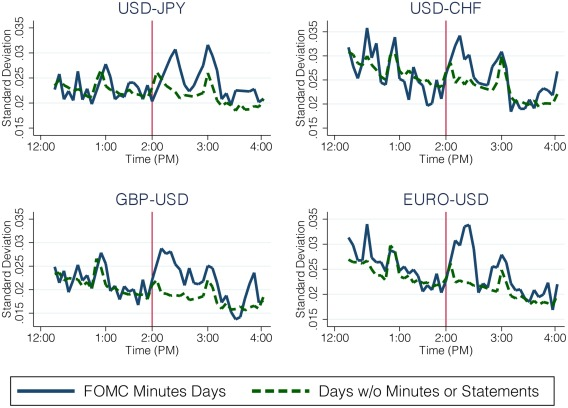
Foreign exchange traders closely watch the minutes for signals about U.S. monetary policy relative to other countries. If the Federal Reserve appears more aggressive than other central banks, the dollar often strengthens.
Because these markets are interconnected, a single sentence in the minutes can move billions of dollars in global capital flows.
Real-World Example: The 2022 Inflation Fight
During the inflation surge of 2022, Federal Reserve minutes became one of the most scrutinized financial documents in the world.
Inflation reached levels not seen in decades, forcing policymakers to rapidly raise interest rates. Investors closely examined each set of minutes to determine whether the central bank would continue aggressive tightening.
In several releases, the minutes revealed that some policymakers supported larger rate increases than initially expected.
Markets reacted immediately:
- Treasury yields surged
- Mortgage rates climbed rapidly
- Growth stocks experienced significant volatility
This example illustrates how the minutes can provide early warning of policy changes before they appear in official decisions.

How Institutional Investors Analyze the Minutes
Professional investors often treat the release of the minutes as a structured research event.
Large asset managers, hedge funds, and banks deploy teams of economists and analysts to review the document within minutes of its publication.
Their analysis typically focuses on:
Tone changes
Analysts compare language with previous minutes to detect shifts in policy thinking.
Voting dynamics
The minutes may reveal how unified—or divided—the committee was on key decisions.
Economic assumptions
Forecasts for inflation, wages, and GDP growth provide clues about future policy.
Risk discussions
References to financial instability or recession risks can change investment positioning.
Because these interpretations happen quickly, algorithmic trading systems often scan the text for keywords and sentiment signals.
Why Retail Investors Should Pay Attention Too
Although institutional investors have more resources, individual investors can still benefit from understanding what the minutes reveal.
Even a high-level reading can help investors interpret market moves and economic conditions.
For example, the minutes can help answer questions like:
- Are interest rates likely to keep rising?
- Is the Federal Reserve worried about a recession?
- Is inflation improving or worsening?
These insights can influence decisions about:
- Asset allocation
- Bond duration
- Sector exposure
- Cash reserves
Long-term investors do not need to trade on every release, but understanding the policy environment helps maintain a disciplined strategy.
How the Minutes Differ From Other Federal Reserve Communications
The Federal Reserve communicates through multiple channels, but each serves a different purpose.
FOMC Statement
Released immediately after the meeting, this short statement announces the rate decision and provides a brief policy explanation.
Press Conference
The Federal Reserve Chair holds a press conference where journalists ask questions about the decision.
Economic Projections
Quarterly forecasts provide policymakers’ expectations for growth, unemployment, and inflation.
Meeting Minutes
The minutes are unique because they provide the most detailed discussion of internal debate.
This depth is why economists and investors treat them as a critical piece of policy transparency.
Common Misinterpretations Investors Should Avoid
While the minutes are valuable, they can also be misunderstood.
Investors sometimes overreact to individual phrases without considering broader context.
Common mistakes include:
- Assuming one policymaker’s opinion represents the entire committee
- Ignoring economic data released after the meeting
- Overinterpreting minor wording changes
- Forgetting the minutes describe past discussions, not necessarily current conditions
Smart investors combine the minutes with other indicators such as inflation data, employment reports, and financial conditions.
How the Minutes Fit Into the Bigger Economic Picture
Federal Reserve policy does not operate in isolation. The central bank responds to evolving economic conditions and global financial developments.
The minutes often reference data such as:
- Consumer price inflation
- Wage growth trends
- Labor market participation
- Financial market stability
- Global economic risks
When these indicators change, the Federal Reserve’s policy stance may shift as well.
Investors therefore use the minutes as one piece of a broader economic puzzle.
What Long-Term Investors Can Learn From Them
While short-term traders may react instantly to the release, long-term investors can use the minutes to understand macroeconomic direction.
Over time, patterns emerge in how policymakers respond to economic cycles.
For instance:
- Rising inflation typically leads to tightening policy
- Weak growth encourages rate cuts
- Financial instability may trigger liquidity support
Recognizing these patterns helps investors maintain perspective during volatile markets.
FAQs About Federal Reserve Meeting Minutes
1. When are Federal Reserve meeting minutes released?
They are typically released three weeks after each Federal Open Market Committee meeting, usually at 2:00 p.m. Eastern Time.
2. Do the minutes predict future interest rate decisions?
Not directly, but they often reveal the conditions that might influence future decisions.
3. Why do markets react so quickly to the minutes?
Because investors are constantly updating expectations about future interest rates.
4. Are the minutes written by Federal Reserve officials?
Yes. They are prepared by Federal Reserve staff and reviewed by committee members.
5. How long are the minutes typically?
Most releases range from 10 to 15 pages, summarizing economic analysis and policy discussions.
6. Do the minutes identify individual policymakers?
No. They summarize viewpoints without attributing comments to specific members.
7. Are the minutes more important during economic crises?
Yes. During periods of high inflation or recession risk, markets scrutinize them more closely.
8. Where can investors read the official minutes?
They are published on the Federal Reserve’s official website.
9. Do all investors pay attention to the minutes?
Large institutional investors almost always analyze them, while retail investors may review summaries from financial news outlets.
10. Can the minutes change long-term market trends?
Sometimes. If they reveal a major policy shift, they can influence market direction for months.
Reading Between the Lines of Monetary Policy
Federal Reserve meeting minutes serve as a rare window into how the world’s most influential central bank interprets the economy. They reveal disagreements, uncertainties, and policy considerations that never appear in official headlines.
For investors navigating inflation cycles, interest-rate changes, and financial volatility, the minutes are more than a bureaucratic document—they are a strategic signal about where monetary policy may head next.
Understanding them does not require being an economist, but it does require paying attention to the signals hidden inside policy discussions.
Key Insights Investors Should Remember
- Federal Reserve meeting minutes reveal internal debates behind policy decisions
- Markets analyze them to predict interest-rate changes
- Small wording shifts can move stocks, bonds, and currencies
- Institutional investors study them immediately after release
- Retail investors can use them to understand broader economic trends
- They are most influential during periods of inflation or economic uncertainty