Summary
Federal Reserve announcements rarely move markets because of the headline decision alone. Professional investors analyze subtle signals embedded in policy statements, press conferences, and economic projections. Changes in wording, tone, voting patterns, and forecasts can reveal the Fed’s future direction on interest rates, inflation control, and liquidity. Understanding these signals helps investors anticipate market reactions before they fully materialize.
Understanding the Hidden Signals in Federal Reserve Policy Updates
Federal Reserve policy updates are among the most closely watched events in global financial markets. While headlines often focus on whether interest rates rise or fall, seasoned investors know that the real story lies beneath the surface.
Policy statements from the Federal Open Market Committee (FOMC), the Fed’s interest-rate-setting body, contain subtle clues about the future direction of monetary policy. These clues—often as small as a single changed word—can move bond yields, equity valuations, and currency markets.
Understanding how investors interpret these signals can help individuals, advisors, and institutional participants make more informed financial decisions.
Why Federal Reserve Communication Matters So Much
The Federal Reserve influences borrowing costs, economic growth, and asset prices through monetary policy tools such as interest rates and balance sheet operations.
When the Fed raises the federal funds rate, borrowing becomes more expensive across the economy. Mortgage rates, credit card rates, and corporate borrowing costs often rise as well. Conversely, when the Fed cuts rates, liquidity increases and financial conditions ease.
Because financial markets are forward-looking, investors try to anticipate future policy moves rather than reacting to decisions after they happen.
According to the Federal Reserve Bank of New York, changes in expectations about future policy often move markets more than the policy decision itself. Investors therefore analyze every aspect of Fed communication to estimate where policy is heading.

The Language Shifts Inside FOMC Statements
One of the most closely studied elements of Fed communication is the wording of the official FOMC statement released after each meeting.
Even minor phrasing adjustments can signal a change in policy outlook.
Investors commonly compare new statements with the previous version line-by-line to detect subtle changes. For example, a shift from “inflation remains elevated” to “inflation has moderated but remains above target” suggests a more optimistic outlook.
Professional investors look for changes in key areas such as:
- Descriptions of inflation trends
- Language about labor market strength
- Assessments of financial conditions
- References to risks facing the economy
When the Fed softens language about inflation pressures, markets may interpret that as a signal that rate hikes could soon pause. Conversely, stronger language can imply further tightening.
The Dot Plot: One of the Most Watched Charts in Finance
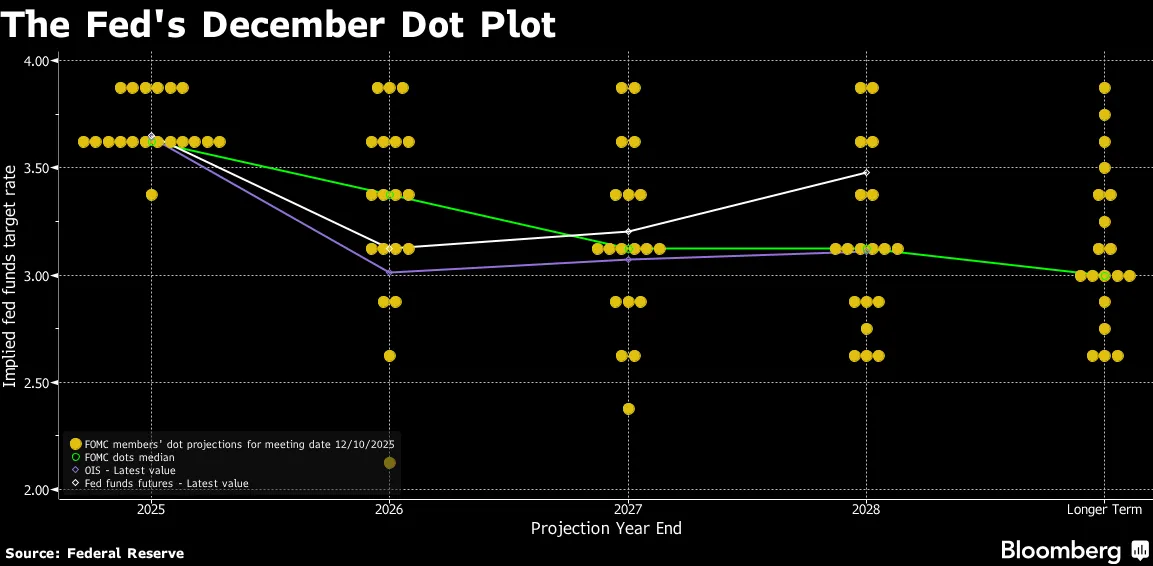
Every quarter, the Federal Reserve publishes the “Summary of Economic Projections,” which includes the famous “dot plot.” This chart shows where each FOMC member expects interest rates to be in the coming years.
Although the dots are anonymous, investors carefully analyze the distribution to understand how policymakers are thinking.
Key things investors look for include:
- The median projected rate for the next year
- Whether projections are moving higher or lower
- The spread between the most hawkish and dovish members
- Changes compared with the previous meeting
If the median dot moves higher than expected, markets may anticipate additional rate hikes. If projections fall, investors may start pricing in future rate cuts.
Because the dot plot reflects policymakers’ expectations rather than commitments, it serves as a directional signal rather than a guarantee.
Tone and Body Language in Press Conferences
After major policy meetings, the Fed Chair holds a press conference. For investors, this event can be as important as the policy decision itself.
Market participants analyze not just what the chair says, but how it is said.
Subtle factors that investors track include:
- Confidence level in the Fed’s inflation outlook
- Willingness to acknowledge economic risks
- Language about the labor market’s resilience
- Clarity about future policy paths
If the Fed Chair appears cautious or emphasizes uncertainty, markets often interpret that as a signal that the central bank may slow its tightening cycle.
Historically, press conference tone has occasionally moved markets dramatically within minutes.
Economic Projections and the Fed’s Internal Forecasts
Another key signal comes from the Fed’s quarterly economic projections.
These forecasts include expectations for:
- GDP growth
- Unemployment
- Inflation (PCE index)
- Long-term interest rates
Changes in these projections often reveal the Fed’s internal assessment of the economy.
For example, if policymakers revise inflation forecasts higher, it suggests they may keep rates elevated for longer. If unemployment projections rise, it may indicate concern about economic slowdown.
Investors often compare these projections with private forecasts from institutions such as Goldman Sachs, JPMorgan, and the Congressional Budget Office.
Voting Patterns Within the FOMC
Each FOMC decision includes a record of votes from committee members. While most decisions are unanimous, occasional dissents can provide insight into internal debates.
Investors pay attention to:
- Whether dissents favor tighter or looser policy
- Which regional Fed presidents are dissenting
- Whether dissent frequency is increasing
For instance, if several members vote against a rate hike because they believe policy is already restrictive enough, investors may conclude that the tightening cycle is nearing its end.
Over time, shifts in voting patterns can signal growing divisions within the committee.
Balance Sheet Signals: Quantitative Tightening and Liquidity
Interest rates are only one part of Federal Reserve policy. The Fed’s balance sheet—built through years of asset purchases—also affects financial markets.
Since 2022, the Fed has been shrinking its balance sheet through a process known as quantitative tightening (QT).
Investors monitor details such as:
- The monthly pace of Treasury and mortgage-backed security runoff
- Any hints that the Fed might slow QT
- Comments about liquidity in financial markets
Changes in balance sheet policy can affect Treasury yields, mortgage rates, and stock market liquidity.
For example, in past tightening cycles, hints of slower QT have often eased financial conditions.
Forward Guidance: What the Fed Says About the Future
Forward guidance refers to explicit communication about future policy intentions.
Over the past two decades, the Fed has increasingly used forward guidance to influence expectations.
Examples include statements like:
- “The Committee expects it will be appropriate to maintain a restrictive policy stance for some time.”
- “Further policy firming may be appropriate.”
Investors examine how forward guidance evolves from meeting to meeting.
If language shifts from “ongoing increases” to “data-dependent adjustments,” it may signal a transition toward a pause.
Forward guidance can influence markets months before any policy change occurs.
Market Reactions: Real-World Examples
Financial markets often react within seconds of a Fed announcement.
A notable example occurred in December 2018, when comments from the Fed Chair suggesting continued rate hikes triggered a sharp stock market decline. Investors interpreted the remarks as too aggressive given slowing global growth.
Another example came in late 2023 when softer inflation language in a Fed statement caused Treasury yields to fall and equities to rally.
These reactions illustrate how investors interpret nuance rather than just the headline decision.
Why Long-Term Investors Still Pay Attention
While day-to-day market movements can seem noisy, Federal Reserve policy has a meaningful influence on long-term asset returns.
Higher interest rates generally pressure growth stocks, real estate, and leveraged sectors. Lower rates often support equities and risk assets.
Understanding the signals embedded in Fed communication helps long-term investors:
- Adjust portfolio risk exposure
- Anticipate bond yield movements
- Evaluate equity valuations
- Plan financing or refinancing decisions
Even investors with diversified portfolios benefit from understanding the central bank’s policy direction.

Frequently Asked Questions
What is the Federal Reserve’s main goal when setting interest rates?
The Federal Reserve aims to achieve maximum employment and stable prices. In practice, that means balancing economic growth with inflation control, typically targeting inflation around 2%.
Why do markets react before interest rates actually change?
Markets are forward-looking. Investors price in expected future policy moves months in advance based on Fed signals and economic data.
What is the FOMC?
The Federal Open Market Committee is the Federal Reserve’s policy-making body responsible for setting the federal funds rate and directing monetary policy.
What does “hawkish” vs. “dovish” mean?
A hawkish stance emphasizes controlling inflation through higher interest rates, while a dovish stance prioritizes economic growth and employment with lower rates.
How often does the Federal Reserve meet?
The FOMC typically meets eight times per year to assess economic conditions and determine policy actions.
What is the “dot plot” investors talk about?
The dot plot is a chart showing where individual Fed policymakers expect interest rates to be in the coming years.
Why do investors analyze press conferences so closely?
The Fed Chair’s comments often clarify how policymakers interpret current economic data and can signal potential future decisions.
Can a single word change markets?
Yes. Markets frequently react to small wording changes in policy statements because they may signal shifts in future policy direction.
Do individual investors need to follow Fed announcements?
While not essential for all investors, understanding Fed policy helps provide context for broader market movements.
Where can investors read official Fed policy statements?
Statements and projections are published on the Federal Reserve’s official website immediately after each FOMC meeting.
Reading Between the Lines of Monetary Policy
Federal Reserve policy updates are dense, technical documents, but they contain valuable insights for those who know where to look. Language shifts, economic projections, voting patterns, and press conference tone collectively shape market expectations.
By learning how investors interpret these signals, individuals can better understand why markets react the way they do and how monetary policy influences the broader economy.
Key Insights Investors Watch Closely
- Small wording changes in FOMC statements often signal policy shifts
- The dot plot reveals policymakers’ interest rate expectations
- Press conference tone can move markets significantly
- Economic projections reflect the Fed’s internal outlook
- Voting dissents highlight divisions within the committee
- Balance sheet policy affects liquidity and bond markets
- Forward guidance shapes investor expectations months ahead