
Long-term investors rarely rely on luck. Instead, they build portfolios around time-tested strategies designed to grow wealth steadily while managing risk. This guide explains the portfolio approaches most commonly used by successful long-term investors—from diversification and asset allocation to dividend investing and index strategies—along with practical examples and real-world insights that help investors build resilient portfolios.
Why Portfolio Strategy Matters for Long-Term Investing
Long-term investing is not about chasing short-term market trends. It is about constructing a portfolio that can grow over decades while surviving market volatility, economic cycles, and unexpected global events.
Research from organizations such as Vanguard Group consistently shows that portfolio structure—especially asset allocation—explains the majority of long-term investment outcomes, far more than individual stock picking.
A well-designed portfolio strategy helps investors:
- Maintain discipline during market downturns
- Reduce overall portfolio volatility
- Capture long-term economic growth
- Avoid costly emotional decisions
Long-term investors typically combine multiple strategies rather than relying on a single method. The following approaches are among the most widely used.
Strategic Asset Allocation
Strategic asset allocation is the foundation of most long-term portfolios. The strategy involves dividing investments among major asset classes—typically stocks, bonds, and sometimes real assets—based on long-term financial goals and risk tolerance.
The concept gained widespread attention through research by economists such as William F. Sharpe and the work of Harry Markowitz, whose work on diversification earned a Nobel Prize.
A typical strategic allocation might look like:
- 60% equities (domestic and international stocks)
- 30% bonds (government and corporate)
- 10% alternative assets (real estate, commodities, etc.)
This allocation is not frequently changed. Instead, it is designed to remain stable over decades.
For example, a 35-year-old retirement investor might maintain a portfolio heavily weighted toward equities because the long time horizon allows recovery from market downturns.
The key advantage of strategic allocation is stability. Investors avoid reacting to short-term market noise and remain focused on long-term growth.
Broad Diversification
Diversification is often called the only “free lunch” in investing.
The idea is simple: spreading investments across many companies, industries, and geographic regions reduces the impact of any single loss.
Instead of owning just a handful of stocks, long-term investors typically hold hundreds or even thousands of securities.
Diversification can occur across multiple dimensions:
- Asset classes: stocks, bonds, real estate
- Geography: U.S., developed international markets, emerging markets
- Sectors: technology, healthcare, finance, energy, consumer goods
- Company size: large-cap, mid-cap, small-cap
A practical example is an investor who owns a total market index fund tracking the S&P 500 while also holding international equity funds and government bonds.
If one sector—such as technology—experiences a downturn, other holdings may offset those losses.
Diversification does not eliminate risk entirely, but it significantly reduces portfolio volatility over long time horizons.
Index Investing and Passive Funds
One of the most influential portfolio strategies of the last 50 years is index investing.
Instead of trying to beat the market by selecting individual stocks, investors simply buy the market itself through index funds or ETFs.
This approach was popularized by John C. Bogle, who created the first retail index fund in 1976.
The philosophy behind index investing is supported by decades of evidence. According to multiple reports from S&P Dow Jones Indices, most actively managed funds underperform their benchmark indexes over long periods.
Advantages of index investing include:
- Very low fees
- Broad diversification
- Tax efficiency
- Minimal management effort
A simple long-term portfolio might include:
- A total U.S. stock market index fund
- An international stock index fund
- A bond market index fund
Many retirement investors maintain this three-fund structure for decades.
Dividend Growth Investing
Dividend growth investing focuses on companies that regularly increase their dividend payments over time.
This strategy appeals to investors who want a combination of income and capital appreciation.
Companies that consistently raise dividends are often financially stable businesses with durable competitive advantages.
Examples often cited by investors include long-established corporations like:
- Procter & Gamble
- Johnson & Johnson
- Coca‑Cola
Many of these companies belong to the well-known group called the Dividend Aristocrats, firms that have increased dividends for at least 25 consecutive years.
Long-term investors reinvest dividends, allowing compound growth to significantly increase portfolio value over time.
For example, $10,000 invested in dividend-paying stocks that grow dividends annually can generate increasing income streams while the underlying shares appreciate.
Dollar-Cost Averaging
Dollar-cost averaging (DCA) is a disciplined strategy where investors invest fixed amounts at regular intervals regardless of market conditions.
Instead of trying to time the market, investors purchase more shares when prices are low and fewer when prices are high.
This approach is widely used in retirement accounts such as those offered through employers.
For example:
- An investor contributes $500 monthly into a retirement account
- Funds are automatically invested in diversified index funds
- Contributions continue through market highs and downturns
Over time, the strategy smooths the impact of volatility.
Research from Morningstar shows that systematic investing can reduce the emotional stress associated with market timing.
For many investors, automation is the most effective way to maintain discipline.
Rebalancing the Portfolio
Even well-designed portfolios drift over time.
If stocks perform exceptionally well during a bull market, they may grow to represent a much larger portion of a portfolio than originally intended.
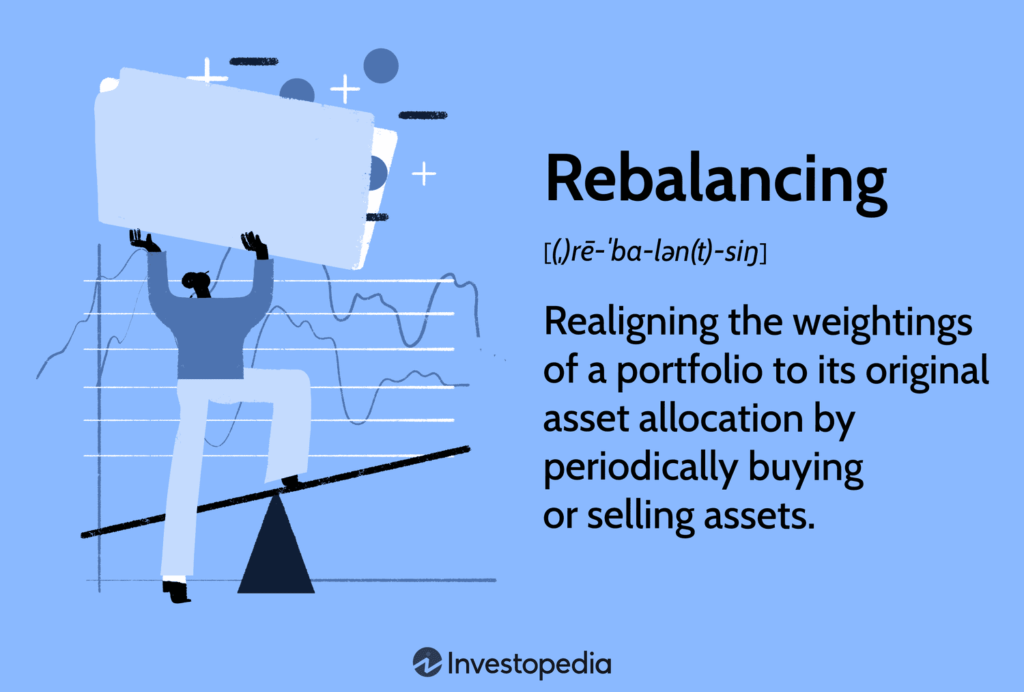
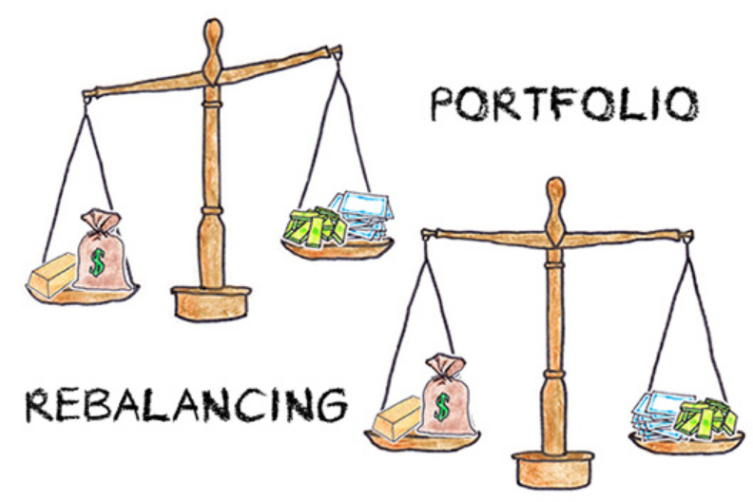
Rebalancing involves periodically restoring the portfolio to its target allocation.
For example:
- Target allocation: 60% stocks / 40% bonds
- After a strong market: 75% stocks / 25% bonds
The investor sells some equities and buys bonds to return to the original balance.
This process accomplishes two important goals:
- Maintains the intended risk level
- Systematically sells high and buys low
Many investors rebalance once per year or when allocations drift beyond certain thresholds.
Long-Term Thematic Exposure
Some investors include small allocations to long-term economic themes expected to shape the future economy.
Examples of popular themes include:
- Artificial intelligence and automation
- Clean energy and climate technology
- Aging populations and healthcare innovation
- Infrastructure development
Rather than dominating the portfolio, these thematic investments typically represent a modest percentage—often 5–10%.
This allows investors to participate in long-term growth trends without exposing the portfolio to excessive risk.
Tax-Efficient Portfolio Design
Taxes can significantly affect long-term investment outcomes.
Experienced investors structure portfolios to reduce tax drag.
Common strategies include:
- Holding tax-inefficient assets (like bonds) inside retirement accounts
- Holding tax-efficient index funds in taxable brokerage accounts
- Harvesting capital losses during market declines
- Minimizing frequent trading
According to data from Internal Revenue Service, capital gains held longer than one year are taxed at lower rates than short-term gains.
This tax structure naturally encourages long-term holding periods.
Behavioral Discipline: The Often-Ignored Strategy
The most overlooked portfolio strategy may be behavioral discipline.
Market volatility can trigger emotional reactions that undermine long-term success.
During market crashes, investors sometimes panic and sell at the worst possible moment. During bull markets, others take excessive risks chasing returns.
Successful long-term investors typically follow several behavioral principles:
- Maintain a written investment plan
- Avoid reacting to daily market news
- Stay invested through market cycles
- Focus on decades, not months
Historical data shows that markets recover over time, but only investors who remain invested participate in that recovery.
Frequently Asked Questions
What portfolio strategy do most long-term investors use?
Most long-term investors use a combination of diversified asset allocation, index investing, and periodic rebalancing. These strategies emphasize steady growth, low costs, and risk management rather than short-term speculation.
How diversified should a long-term portfolio be?
A typical diversified portfolio includes exposure to hundreds or thousands of securities across multiple sectors and global markets through index funds or ETFs.
Is stock picking necessary for long-term investing?
Not necessarily. Research from financial institutions shows that many professional stock pickers underperform broad market indexes over long periods.
How often should a portfolio be rebalanced?
Many investors rebalance once per year or when allocations drift significantly from the target structure.
Are dividend stocks good for long-term investing?
Dividend-growing companies can provide both income and long-term capital appreciation, especially when dividends are reinvested.
What percentage of a portfolio should be in stocks?
The percentage depends on risk tolerance and time horizon. Younger investors often allocate 60–90% to equities, while retirees typically hold more bonds.
Is dollar-cost averaging better than lump-sum investing?
Dollar-cost averaging reduces emotional decision-making and market timing risk, though lump-sum investing may sometimes produce higher returns in rising markets.
Should long-term investors invest internationally?
Many experts recommend global diversification because economic growth occurs across multiple regions, not only in the United States.
What is the biggest mistake long-term investors make?
One of the most common mistakes is panic selling during market downturns, which locks in losses and prevents recovery participation.
Can a simple portfolio outperform complex strategies?
Yes. Low-cost diversified portfolios often outperform complicated strategies because they minimize fees, trading costs, and behavioral mistakes.
Designing a Portfolio That Can Last Decades
Successful long-term investing rarely relies on complex tactics or constant market predictions. Instead, durable portfolios are built on simple principles: diversification, disciplined contributions, low costs, and patience.
While markets will inevitably experience volatility, investors who follow structured portfolio strategies are better positioned to stay invested and benefit from the long-term growth of the global economy.
Over time, consistency often proves more powerful than complexity.
Key Lessons for Building a Durable Investment Portfolio
- Long-term investing works best when portfolios are diversified across multiple asset classes.
- Strategic asset allocation determines most long-term investment outcomes.
- Index investing offers broad exposure with low costs.
- Dividend growth stocks can provide reliable income and long-term appreciation.
- Dollar-cost averaging helps investors stay disciplined through market cycles.
- Periodic rebalancing maintains risk levels.
- Behavioral discipline is essential for long-term success.