Long-term investors approach money with patience, discipline, and a focus on compounding rather than quick gains. Research from institutions such as Vanguard, Fidelity, and the Federal Reserve shows that individuals who prioritize diversification, consistent investing, and multi-decade planning tend to build significantly more wealth than those focused on short-term market movements or speculative opportunities.
The Mindset Difference That Shapes Financial Outcomes
For many Americans, investing can feel unpredictable and intimidating. Market headlines often highlight daily fluctuations, economic uncertainty, or sudden investment trends. However, long-term investors tend to see money differently.
Instead of reacting to short-term events, they focus on how financial decisions unfold over decades. This mindset shift influences how they save, invest, and evaluate risk.
According to research from Vanguard, investors who remain consistently invested in diversified portfolios typically outperform those who frequently buy and sell based on short-term market signals.
The difference is not necessarily greater intelligence or access to special information. Rather, it comes from a different framework for thinking about money.
Long-term investors treat financial decisions as part of a slow, strategic process rather than a series of rapid choices.
They Measure Time in Decades, Not Market Cycles
One of the most important differences in long-term thinking is the time horizon used for financial decisions.
Many investors evaluate performance over months or even weeks. Long-term investors, by contrast, often evaluate financial strategies over 20, 30, or even 40 years.
This perspective affects how they respond to market volatility.
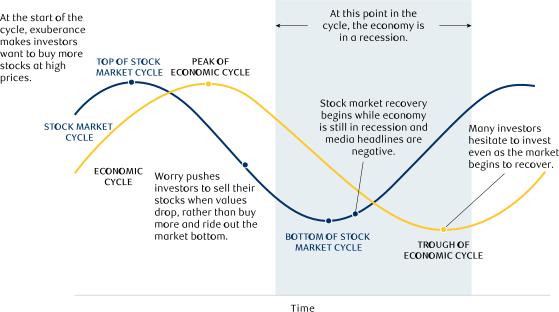
For example, when stock markets decline temporarily, long-term investors often interpret the event differently than short-term traders. Instead of seeing a crisis, they may view it as a normal part of market cycles.
Historical data supports this perspective. According to S&P Dow Jones Indices, the U.S. stock market has experienced numerous downturns throughout history, yet long-term market trends have consistently moved upward over extended periods.
This long horizon helps investors avoid decisions driven by fear or short-term uncertainty.
They Focus on Ownership, Not Trading
Another key mindset difference involves how long-term investors view investments themselves.
Short-term investors often think in terms of transactions—buying and selling assets to capture price movements.
Long-term investors tend to think in terms of ownership.
When they invest in stocks, for example, they often view themselves as partial owners of businesses rather than traders of financial instruments.
This perspective encourages a more patient approach to investing. Instead of asking whether a stock price might rise next month, long-term investors consider questions such as:
- Is this company or index likely to grow over the next decade?
- Does this investment fit within a diversified portfolio?
- Does it align with long-term financial goals?
By focusing on ownership, investors shift attention away from short-term price movements and toward long-term economic growth.
They Prioritize Consistency Over Perfect Timing
A common misconception among new investors is that success requires predicting market movements.
Long-term investors generally reject this idea. Instead, they prioritize consistent investing regardless of short-term conditions.
Many follow structured strategies such as dollar-cost averaging, which involves investing fixed amounts at regular intervals.
This approach offers several advantages:
- It reduces the pressure to time market entries perfectly
- It spreads investment purchases across different price levels
- It encourages disciplined financial habits
Over time, consistent investing allows portfolios to benefit from both market recoveries and long-term economic growth.
They Understand the Power of Compounding
Compounding is one of the most powerful concepts in finance, and long-term investors place significant emphasis on it.
Compounding occurs when investment returns generate additional returns over time.
The effect grows stronger as investment horizons lengthen.
For example, an individual investing in their early 20s may benefit from several decades of compounded growth before retirement.
Financial planners often highlight that starting early can be more impactful than investing large amounts later in life.
Even modest contributions can grow substantially when given sufficient time.
This is why many long-term investors prioritize beginning their investment journeys as early as possible.
They Diversify to Manage Risk
Another defining characteristic of long-term investors is their emphasis on diversification.
Instead of concentrating investments in a small number of assets, they typically distribute investments across multiple asset classes.
A diversified portfolio might include:
- U.S. stock market index funds
- International equity funds
- Bonds or fixed-income investments
- Real estate or real estate investment trusts (REITs)
Diversification reduces the risk that a single economic event or industry downturn could significantly harm an investor’s portfolio.
According to research from Morningstar, diversified portfolios often produce more stable long-term results compared to highly concentrated investments.
This approach reflects a fundamental principle of long-term investing: risk management is just as important as return generation.
They Ignore Short-Term Noise
Financial news coverage often emphasizes daily market activity.
Headlines about interest rate decisions, political developments, or quarterly earnings reports can create the impression that constant action is required.
Long-term investors typically filter out much of this noise.
Instead of reacting to every market development, they focus on core financial fundamentals such as:
- Asset allocation
- Investment costs
- Contribution rates
- Long-term economic trends
This approach helps investors maintain discipline and avoid emotional decision-making.
It also reduces the likelihood of buying high during periods of market excitement or selling low during downturns.
They Keep Investment Costs Low
Costs play an important role in long-term investment outcomes.
Fees associated with trading, fund management, or advisory services can gradually reduce investment returns over time.
Long-term investors often prioritize low-cost investment vehicles, particularly diversified index funds.
Research from Vanguard has shown that lower investment costs tend to correlate with stronger long-term investor outcomes.
By minimizing unnecessary expenses, investors allow a larger portion of their returns to remain invested and continue compounding.
They Treat Investing as a Habit
Another key difference is how long-term investors integrate investing into their financial routines.
Instead of making occasional large investments, they treat investing as a regular financial habit.
Common habits include:
- Automatic monthly contributions to investment accounts
- Consistent retirement plan participation
- Reinvesting dividends
- Periodic portfolio rebalancing
These routines help investors maintain progress regardless of market conditions.
Over time, habitual investing creates a steady flow of capital into long-term assets.
They Align Investments With Life Goals
Long-term investors often begin with clear financial goals.
These goals might include:
- Retirement security
- Financial independence
- Funding education for children
- Creating long-term financial stability for future generations
By aligning investment decisions with specific goals, investors maintain focus during periods of market volatility.
Instead of reacting emotionally to short-term performance, they evaluate progress relative to long-term objectives.
This perspective encourages patience and strategic decision-making.
Frequently Asked Questions
What is long-term investing?
Long-term investing involves holding assets such as stocks or funds for many years, often decades, to benefit from compounding and economic growth.
How long is considered long-term in investing?
Many financial professionals define long-term investing as maintaining investments for 10 years or longer, particularly for retirement planning.
Why do long-term investors ignore short-term market changes?
Short-term market fluctuations are common and often unpredictable. Long-term investors focus on broader economic trends rather than daily price movements.
What investments are commonly used for long-term strategies?
Diversified stock funds, retirement accounts, bonds, and real estate are commonly used in long-term investment portfolios.
Is diversification really necessary?
Yes. Diversification spreads risk across multiple asset classes, helping protect portfolios from major losses.
How much should someone invest regularly?
Many financial planners recommend investing 15–20% of income, though individual circumstances may vary.
Why are index funds popular among long-term investors?
Index funds offer diversification and low costs, making them attractive for long-term investment strategies.
Do long-term investors ever change their portfolios?
Yes. Investors periodically rebalance portfolios to maintain their desired asset allocation.
Can beginners adopt a long-term investment strategy?
Yes. Many beginners start with simple diversified funds and gradually expand their portfolios as they gain experience.
What is the biggest advantage of long-term investing?
The greatest advantage is compounding, which allows investments to grow exponentially over extended periods.